
Circular Economy

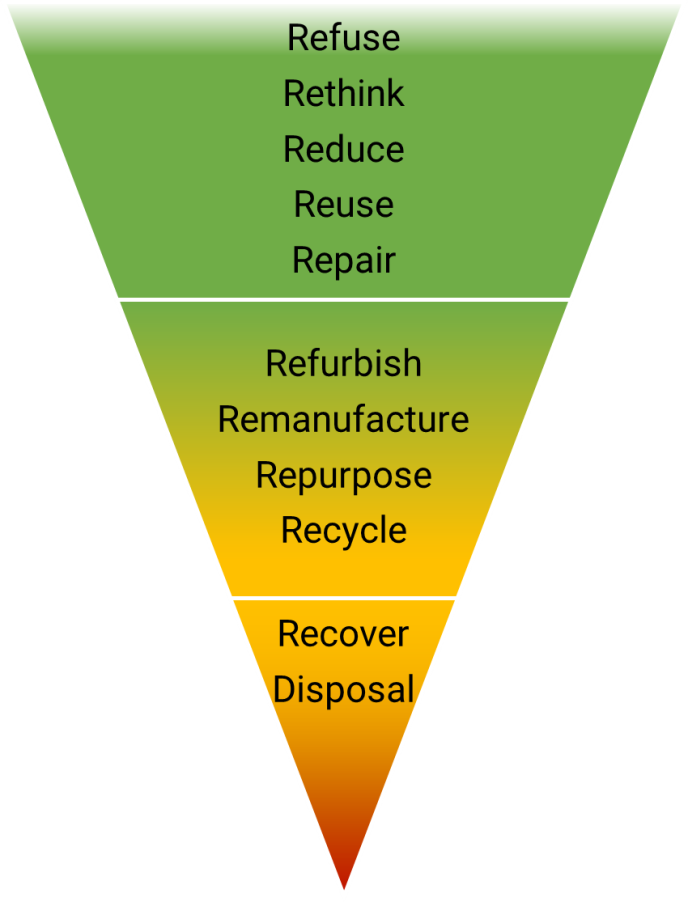
The earlier circular economy principles are applied, the greater the impact. Unlike the linear model where materials become waste after use, the circular economy keeps resources in circulation. Products are designed to last, be reused, and recycled minimizing waste and maximizing value.

Circular economy hierarchy

Refuse: Eliminate the need for the product by giving up its functionality or by achieving the same functionality in another way.
Rethink: Utilize the product more efficiently by sharing it with multiple parties (sharing) or by finding multiple uses and ways to use it.
Reduce: Increase the efficiency of machines and equipment in the production process or use fewer raw materials for the same product.
Reuse products that are no longer in use in the same purpose but by another user.
Repair faulty products so that their original functionality is preserved.
Refurbish: Update old products to meet today’s requirements.
Remanufacture: Utilize the functional components of the product in the manufacture of new, similar products.
Repurpose: Use the product or its components in the manufacture of a new, different product.
Recycle: Use the materials of the product in the manufacture of new products.
Recover: Utilize the energy embedded in the materials by incineration.
Disposal: Send to final disposal (e.g., landfill) only waste for which there is no utilization option.

Oulu’s Commitment to the Circular Economy

The City of Oulu began its circular economy journey by signing the Circular Cities Declaration in 2020. To accelerate the transition, the city developed a Circular Economy Roadmap in 2021, with a vision to become a learning circular city.

With support from the URBACT Let’s Go Circular! project, the roadmap has since been updated into a Integrated Circular Economy Action Plan.