

10. Intangible cultural heritage workshops
Contents of this page:
- Placeholder
Equal Oulu2026, Northern Ostrobothnia Museum's BestBeloved Museum Project, Kainuu Museum, University of Oulu's Mobile Futures project, Oulu vocational school, Kainuu community college and Arffman and Spring House implemented Intangible Cultural Heritage workshops for immigrant students in integration training in Oulu and Kajaani.
Every person's fundamental cultural rights include the right to participate in the arts, culture, to express themselves freely, and to develop themselves and their community through art and culture. Supporting the maintenance and preservation of immigrants' own language and culture supports integration, promotes good demographic relations, intercultural dialogue, and cultural well-being and inclusion. Intangible cultural heritage is a part of people's lives and is strongly present in people's everyday lives. Maintaining a cultural heritage that is important to one's self strengthens one's identity and sense of belonging.
The aim of all the Intangible Cultural Heritage workshops was to learn about the cultural heritage that people of different language and cultural backgrounds and communities maintain in the area of the European Capital of Culture Oulu2026.
One of the aims of cultural climate change in the European Capital of Culture is to create a balanced community in which opportunities are created so that everyone's cultural well-being and inclusion are realised. In such a community, culture acts as a constructive force for a better future. A diverse cultural heritage is always formed by the interaction of people and cultures. Our goal is to enable cultural heritage to interact and make diversity visible in the European Capital of Culture region. The recognition of diversity is a prerequisite for the realisation of an equal culture.
Intangible Cultural Heritage and Inclusion
The purpose of the workshops was to develop ways for cultural actors to strengthen the inclusion of immigrants.
Intangible cultural heritage is a very suitable subject for co-development with immigrant students. The theme makes it possible to discuss topics that are familiar to students, that they are proud of, and that they want to share with others. Students are experts in their own living cultural heritage.
This is a topic of common interest that generates a great deal of discussion.
The workshops use a lot of visual materials, which is why the workshops are also successful in the early stages of studying the Finnish language.
The promotion of culturally diverse intangible cultural heritage as part of the activities of municipalities and urban cultural institutions provides good opportunities to actively influence and co-develop local residents, communities and their organisations from different linguistic and cultural backgrounds, strengthens their activities as part of local cultural life, and at the same time promotes a sense of belonging among diverse communities.
Through the "intangible cultural heritage" -themed events, cultural actors are well positioned to bring out diverse cultural identities and expressions and to create different opportunities for immigrant residents to participate in different roles. The events provide an opportunity to work together with communities of different linguistic and cultural backgrounds, to produce and share the common good with others, and to meet different population groups.
Intangible Cultural Heritage - Guidelines for workshop leaders
The Intangible Cultural Heritage Workshops are the first step in enabling cultural institutions in municipalities and cities to engage in joint discussion and co-development with immigrant students.
The Intangible Cultural Heritage workshops are intended for immigrant students in integration education. The aim of the workshops is to get to discuss with students about culture and intangible cultural heritage and to brainstorm cultural events to promote culturally diverse living cultural heritage.
The workshops are suitable for all groups of integration education, regardless of the Finnish language skills of the students.
The workshops are held in two parts, between which students receive a homework assignment. Each workshop with breaks lasts three hours. The two parts of the workshops should be held approximately a week apart from each other.
The downloadable slides of the workshops can be found at the end of the page. If necessary, you can customize the PowerPoint presentations to fit your workshop. The instructions for the workshops can be found as downloadable pdf files as well as in text format in the accordion menu below.
Workshop 1 - instructions
SLIDE 1–2
The workshop leaders introduce themselves. Tell students who you are and who you represent. In the beginning, it is intended to tell you what the purpose of the workshops is. Also tell us about the schedule of the workshops. Tell us how you will be able to utilise the results of the workshops in your own operations and in the development of your diversity work.
SLIDE 3
The students introduce themselves. Ask everyone to tell you briefly about themselves. For example, where the student is from, what their occupation and/or favorite hobby is, and how long they have lived in Finland.
SLIDE 4
What is living/intangible cultural heritage? We start by asking students what living cultural heritage means. Are the words: living, intangible, cultural, or heritage familiar? What do they mean separately? What kinds of meanings or examples come to mind for students? You can explain the Living Cultural Heritage by using the definition of the Finnish Heritage Agency: ”Intangible cultural heritage is the living heritage which is present in people’s everyday lives, encompassing all forms of human activity. For example, it can be knowledge and skills relating to oral traditions, performing arts, festivities and practices, crafts, or nature and the universe. These can then take form of objects, different forms of expression, or even food and games.”
SLIDES 5-13
With the following slides, we go through categories of living cultural heritage, such as celebrations, stories and games, nature, etc. Ask students to give examples of each category that are familiar and important to them. Encourage them to share memories, experiences, and stories about examples.
SLIDE 14
Is there a familiar tradition in the words? Slide has a word cloud that presents examples of living cultural heritage selected by the students of the Hakarinne school in Tammisaari. Ask the students if there is a familiar tradition in the words. Start the conversation by asking more about their experiences, e.g. have you eaten (rosolli), have you tried (reindeer ride, ice swimming), have you played (ice hockey), do you like (salmiakki, sauna), etc.
SLIDE 15
The same question and discussion continues. The slide shows examples of a wiki list of living cultural heritage. You can prepare in advance to tell students what the examples mean and/or by searching online with students for images of inheritances that are not familiar.
SLIDE 16
Break
SLIDE 17
After the break, a brief recap of what was discussed in the group. Ask students to tell us once again what living cultural heritage means.
SLIDE 18
Finnish cultural heritage. Show students a video of the Finnish sauna tradition. The video is part of a presentation sent to UNESCO from 2020 and today the Finnish sauna tradition is part of UNESCO's list of the intangible cultural heritage of mankind. Ask what kind of thoughts the video and sauna tradition evokes.
SLIDE 19
Are there only Finnish traditions in Finland?
Tell students that the sauna tradition is an integral part of Finnish culture and it is Finland's first item in UNESCO's list of Intangible Cultural Heritage of Humanity.
Start a discussion about what Finnish cultural heritage means. You can use Yle's video, which asks which Finnish intangible cultural heritage should be protected.
The purpose of the discussion is to highlight the living cultural heritage maintained by culturally diverse and immigrant communities, which is to be identified and made visible in Finland.
SLIDE 20
Wiki list of living cultural heritage.
Go through the link to the Living Cultural Heritage wiki list page and let us know that the site presents examples of living heritage in Finland. Explain that it is possible to make suggestions from the Wiki List to the National List of Living Heritage and that each group or community can add their own suggestions.
SLIDES 21-24
The following slides are used to go through examples of culturally diverse living cultural heritage that can be found in the list, for example:
•Mexican Day of the Dead in Finland
•Latvian tradition of dyeing eggs in Finland
•Iranian classical music in Finland
•Celebrating Chilean Independence Day in Finland
SLIDES 25-28
Group work
Divide students into small groups (5-10 people per group).
Ask each student to choose one example of living cultural heritage that is important to them and that they maintain in Finland. Students take turns sharing examples in small groups. They can show pictures and videos.
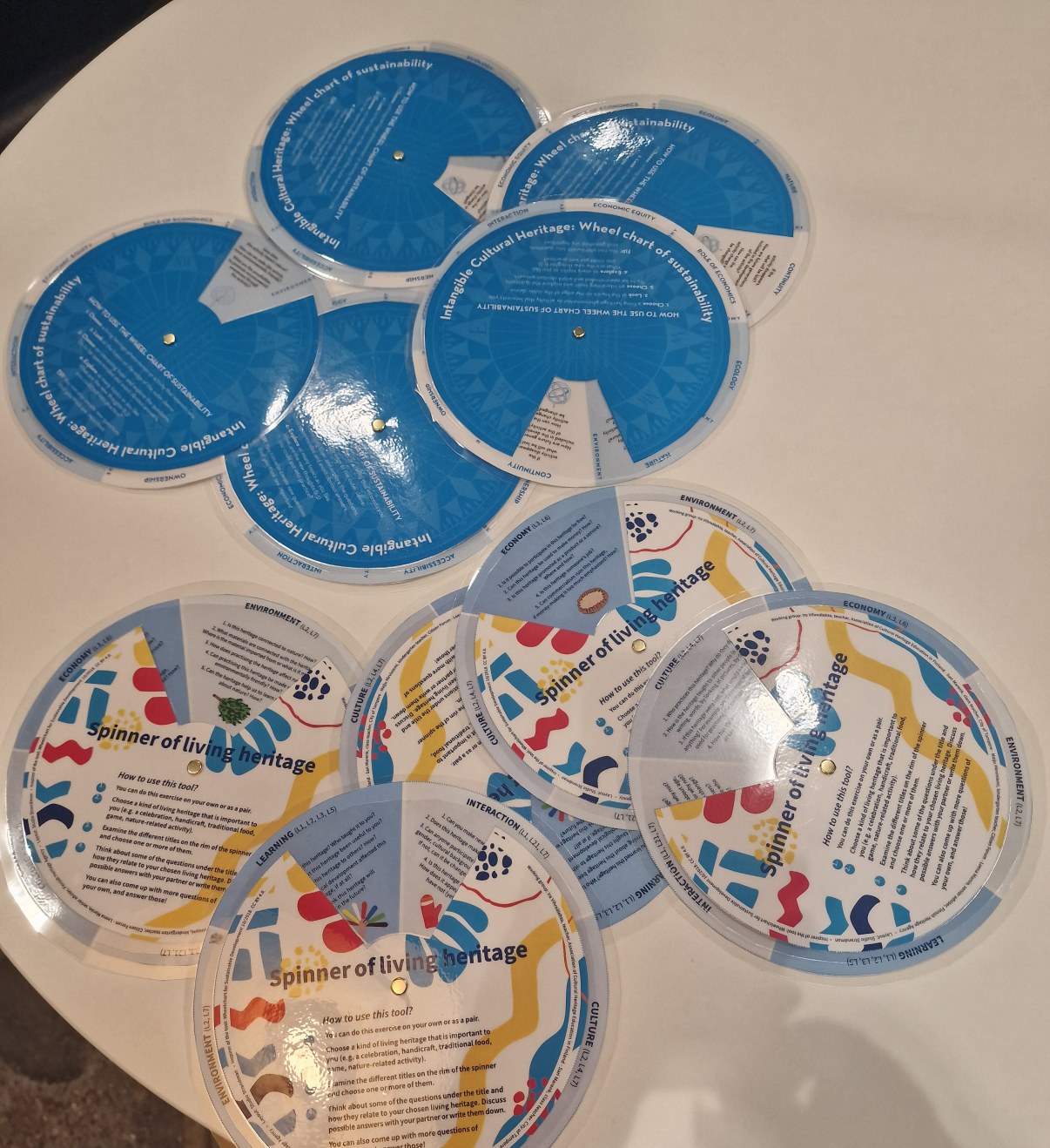
Ask students to consider questions about the Heirloom (you will move to a new page), such as:
Learning
1. How have you learned this legacy? Who taught you that?
2. What has been the benefit to you of learning this legacy?
3. Have you taught heritage to others? How?
Interaction
1. Is it possible to make new friends through this legacy?
2 Will this legacy make you feel good? Why is that?
Can everyone contribute to this heritage (e.g., age, gender, cultural background, disability)? If not, can it be changed?
4. Is this a valued legacy? How do you see it?
Economy
1. Is it possible to participate in this heritage for free?
2. Can this legacy make money? How?
3. Is this legacy being advertised? Where and how?
4. Is this a legacy of someone's profession?
5. Can commercialism ruin this legacy? How?
Culture
1. Who is carrying on this inheritance? Why?
2. How is inheritance passed on to other people (e.g., in writing, verbally, figuratively, by doing)?
3. If a heritage were to be lost, what would be lost with it?
4. How does the heritage/tradition change or can it be changed?
Environment
1. How is nature involved in the heritage?
2. What material is involved in the inheritance? Where is the material imported/made from?
3. How does heritage affect nature?
4. Can heritage be made more environmentally friendly? How?
5. Can heritage help us learn more about nature? How'?
SLIDE 29
Homework:
For next time, bring along something of your own living heritage (object, picture, story...) that you will present in the group.
Tell students that in the second part of the workshop, students present the whole group with examples of living cultural heritage in their own home country. Ask them to bring heritage-related materials, such as items, crafts, clothing, stories, or presentations of PowerPoint, if possible. The performances do not have to be long, no more than 7 minutes. If there are more students from the same country in the group, they can make a group presentation if they wish.
Workshop 2 - instructions
SLIDE 1
Welcome words and workshop schedule.
SLIDE 2
What do you remember from the previous workshop?
Ask students to briefly explain what the topic of the first workshop was and what was done at that time.
SLIDE 3
Card game.
Print and cut a set of Living Heritage cards and/or a photo package to help students learn about and discuss the phenomena and examples of living heritage in Finland and other countries.
Download the living heritage card deck here.
Download the picture package here.
Give students task instructions:
Everyone chooses an interesting card and presents the card to the whole group.
Tell us why you chose the card, what you know about tradition, why it is interesting, etc.
If the tradition of the image is not familiar, search the web for information.
Each student tells the whole group about the tradition of their own card.
SLIDE 4
Homework presentations.
In the previous workshop, students were asked to prepare presentations on examples of living cultural heritage of their own culture. Now is the time to present their work alternately to the whole group. Take care of the schedule so that each student can tell about their own tradition. Encourage the whole group to ask questions after each presentation.
SLIDE 5
Culturally diverse cultural heritage in Finland.
After the performances, remind that the aim of the workshop is to consider how the examples of living cultural heritage presented by students, among others, can be made more visible in local cultural life.
SLIDE 6
How can cultural heritage be shared with others?
Ask students how they can share their heritage with others. In what ways could we make culturally diverse living cultural heritage visible and familiar to all? How could we invite others to explore and participate in the diverse living cultural heritage?
SLIDE 7
Events.
An event is a way to make culturally diverse living cultural heritage visible and to invite local communities to enjoy it.
SLIDES 8–13
Next, show students examples of what kind of events take place in Finland: World Village Festival in Helsinki, Chinese New Year in Helsinki, Latin Folk Night in Helsinki, Kolibri Cultural Diversity Festival in Helsinki, Arabian Language Day and Being Black - Afro-Finns’ experiences exhibition in Helsinki.
SLIDE 14
Ask students, do they know if similar events are taking place in their area? Have they heard, participated in, or organized cultural diversity events?
SLIDE 15
If events promoting cultural diversity have been organised in the area, you can prepare in advance and add your own examples to the slides.
SLIDE 15–18
Events promoting culturally diverse living cultural heritage from Oulu (examples).
SLIDE 19–20
Group assignment.
The groups plan events that promote a culturally diverse living cultural heritage that they themselves would like to participate in or that they would like to organise.
Divide students into small groups (5-10 students per group).
Enter task instruction:
The group plans one event.
What cultural heritage: celebration, craft, dance, stories...
What event: e.g. craft workshop, festival, concert...
For whom, e.g. whole families, young people, women?
The name of the event?
Duration of the event, e.g. 2 hours, all day.
Where is it? E.g. Museum, Culture Centre Valve, Library?
When?
The groups present the results to everyone.
SLIDE 21
After the presentations, we will have a final discussion together.
For example, ask students:
What ideas did the workshop evoke?
What did you learn?
What would you like to know more about?
Results of the workshops
In the workshops, the intangible cultural heritage events designed by immigrant students can be divided into five categories. Categories can serve as inspiration for cultural actors to develop living cultural heritage activities in the context of cultural diversity and immigrant cultural inclusion.
1. Making global intangible cultural heritage visible
The aim is to actively promote living cultural heritage also outside Western art and culture. In cooperation with communities of different language and cultural backgrounds, cultural institutions plan to organise different days and celebrations as part of their own public work and cultural activities.
2. Dialogue between cultures
Events aimed at building bridges between people and culture. Opportunities that enable interactions between diverse people and their cultural identities and expressions and the emergence of new meanings. The goal is to highlight that cultures have always influenced each other and have always been in constant change.
In the process of intercultural dialogue, the sharing of knowledge, skills and practices is, on one hand, the maintenance of a living cultural heritage as a means and, on the other hand, the creative source of new traditions, values and meanings.
3. Encounters and Inclusion
The cultural institutions of municipalities and cities serve as a low-threshold meeting and influencing place for different population groups. The aim is to open up and create safer spaces and activities where diverse people could show their expertise, influence the development of cultural activities and feel community and cohesion.
4. Everyone's stories
Events aimed at promoting good demographic relations through narrative means. The stories serve as a symbolic forum for promoting polyphony in cultural institutions. They are also an integral part of living cultural heritage and its sharing and maintenance.
Cultural institutions can use storytelling events to influence whose stories are told, who is telling and who is making their voices heard. At the same time, they can contribute to allowing marginalized groups to tell their own histories.
5. Inclusion of all
A living cultural heritage is created and lives in communities.
Cultural institutions support the activities of diverse communities and the promotion of their living cultural heritage. This requires the development of more inclusive policies by those involved, with the aim of involving everyone and ensuring that under-represented groups are able to participate on an equal basis in the production of cultural content.

Equal Oulu2026 -project is co-founded by the European Union.