


Culture of Multicolored Circles
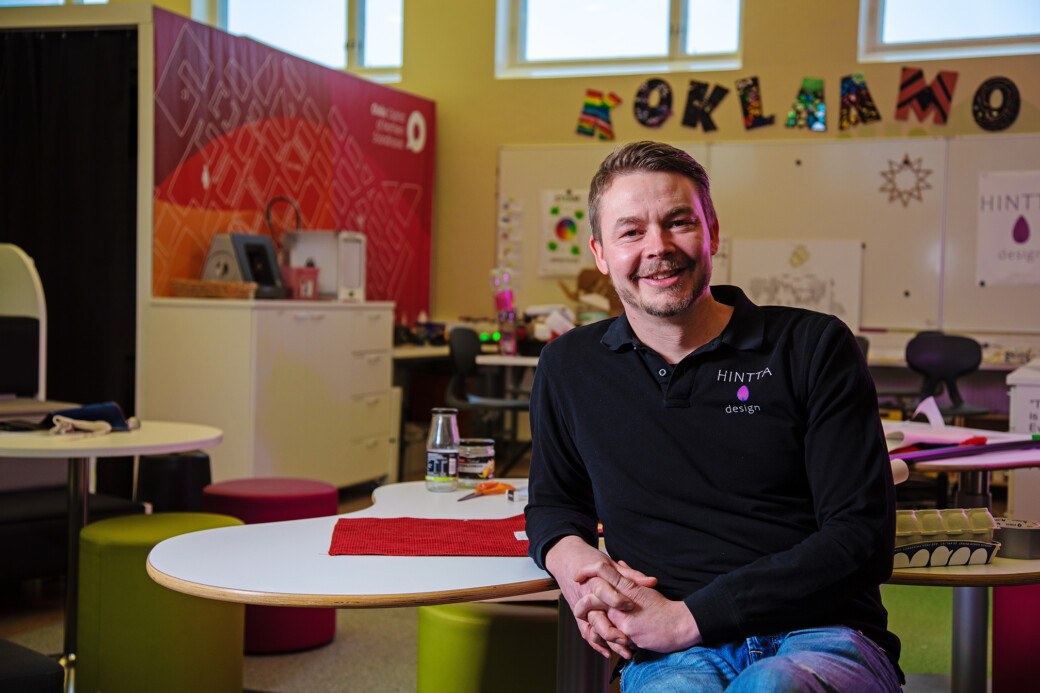
In Hintta Elementary School, we believe in the joy of learning. The power of joy does not only concern the students, but trying and experiencing new things also motivates the teachers. Teacher Pekka Pöyhtäri, who has taught in the school for years, talks about leaping into the new.
Silence hangs over Koklaamo. It is half past eleven on a Friday – lunch is over, and the pupils of Hintta School spill over the school hallways to chat and hang out.
Teacher Pekka Pöyhtäri has some time for a chat now. The topic is clearly important to Pöyhtäri who has taught in the school since 2005. And the topic is not small. Or what do you think of the joy of learning?
Creating a good atmosphere for students
Hintta Elementary School is called a STEAM school with good reason. Or as Pekka Pöyhtäri states, a school where the joy of learning encourages pupils to learn.
“STEAM has been revolutionary in changing our entire school’s working culture”, Pöyhtäri speaks with a calm and pleasant voice.
There is a circular poster in Koklaamo, Hintta School’s Makerspace, that reads Goal in Finnish. The goal is surrounded by smaller circles that read: Task, Research, Ideation, Planning, Implementation, and Sharing.
The colorful set of circles tells students the order of things. The result is always a surprise, but the process is in itself a learning experience. Pöyhtäri explains that he has experienced moving stories of how pupils have grown as learners. The same applies to the teachers.
“This is a learning experience for us teachers too when we leave old working models behind and embrace new things. Learning and developing new things simultaneously makes our work exciting.”
When students no longer only stopped by
Pöyhtäri explains that he got into STEAM through technology rather than pedagogy. About five years ago, the school had acquired brand-new devices, such as a 3D printer and a vinyl cutter, but the most important thing was missing.
“I was a craft teacher. The students stopped by the machines. It bothered me that I couldn’t create connections with them”, Pöyhtäri exclaims.
In hindsight, many things ended up happening at once: firstly, Pöyhtäri was asked to become a classroom teacher. Secondly, he visited the opening of the Värkkäämö Makerspace in Yli-Ii School.
“This would work for us too”, Pöyhtäri remembers thinking about the brand-new creation space.
Inspiration was high, but it took a while for pieces to fall into place. The pieces were Principal Matti Ahola’s excitement for STEAM, a class shared with colleague Maikki Manninen, implementation of STEAM work, and a business partner Lekolar. Koklaamo, the room in which Pöyhtäri is now reminiscing about the birth of STEAM, is a so-called Makerspace: an open space for trial and creation. Students no longer only stopped by Pöyhtäri’s desk.
“STEAM handles wide themes and encourages learning by combining subjects. When just working itself is fun and joyful, learning just happens on its own.”
Hintta Design and the final question
Pöyhtäri is interrupted when a young student comes in to ask about materials.
“For earrings, right?” Pöyhtäri specifies and promises to help in fifteen minutes.
It is Christmas time and thus peak time for Hintta Design. The product brand is owned by the school, and products are naturally designed by the students. The brand has its own online store operated by a parents’ association. The proceeds go to the school’s shared trip budget.
Before Pyöhtäri leaves to help eager students, he answers the final question: which aspect of STEAM should be highlighted.
“Cooperation with other teachers.”
An even greater achievement
When Pöyhtäri worked as a craft teacher and could not always create a connection with his students, there was another issue: there were no proper connections with the other teachers either. He worked a little with the textile craft teacher, but physically they worked on opposite sides of the school.
“Multidisciplinary work forces everyone to communicate”, Pyöhtäri sums up STEAM’s importance.
For example, the school has three fourth grade classes, and one of them is taught by Pöyhtäri. Classroom teachers often work together: thinking, planning, and implementing. Some classes are also held together. According to Pöyhtäri, it is both more efficient and more meaningful.
Pöyhtäri is proud of the results: how a group of excited teachers, principals, and cultural operators have promoted STEAM together. STEAM has been recorded widely, for example, in the city of Oulu’s City Strategy. It is also visible in Oulu2026 European Capital of Culture’s themes.
The achievement is great, since STEAM launched from basically nothing. Even though there was no money or paid overtime hours, there was something else. You will likely guess what.
Yes, enthusiasm and joy for learning.