


ToolCamp 2027 – Oulu's largest STEAM competition
Contents of this page:
- Placeholder
ToolCamp challenges children and youth in Oulu to solve topical challenges.
#toolcampoulu @steaminoulu
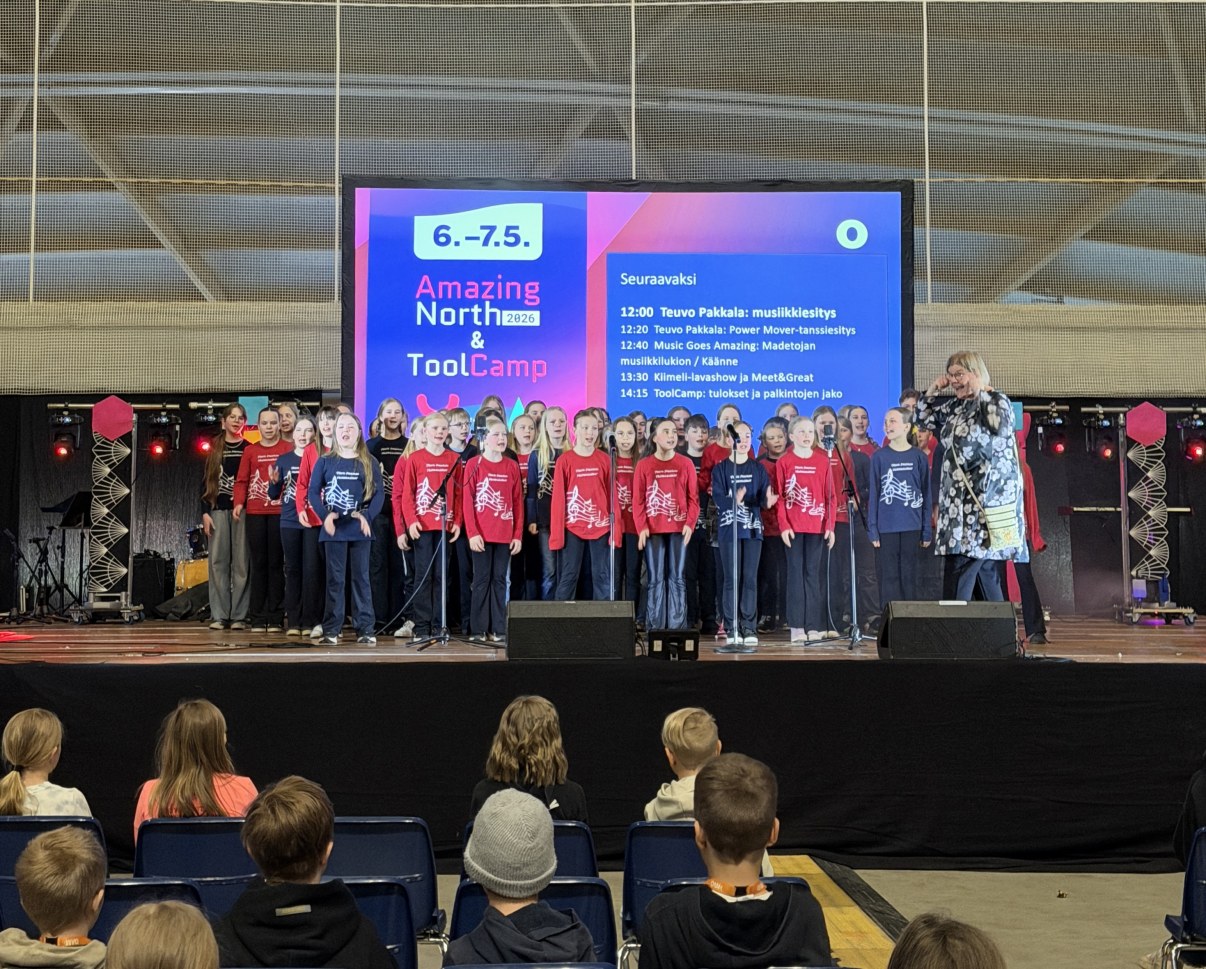
ToolCamp is an annual event that celebrates imagination, creativity, and cooperation. During the event, children and youth take on challenges and ideate solutions.
ToolCamp is a totality that consists of activities at daycare centres and schools. The event culminates with the ToolCamp Day. Children and youth initially work in groups in their own units, and representatives are chosen for the ToolCamp Day. During the Day, the groups will present their creative and sustainable solutions to the public and the jury.
ToolCamp is organized by the city of Oulu’s Steam in Oulu network.

ToolCamp 2027
During the ToolCamp Day, representatives of units will present their solutions on fair desks and with short presentations. There is programming for teachers as well.
More information and schedule will be revealed in Autumn 2026. Check back later!
Design Challenges
You may choose one or several challenges for your unit or group. Each group will formulate a solution for one challenge. You may contact the specialist teams when preparing for the challenge if you need further information.
Challenge #1 – The Best Play Ever!
What’s the best game, and where’s the nicest place to play? What sort of game would keep going and going with new ideas all the time?
We challenge you, children, to design and build your own dream game or play area. You can think about where the game will take place (outdoors, indoors), what equipment is needed, what materials the equipment will be made from, and what characters will feature in the game.
Challenge's experts will be revealed soon!
Challenge #2 – Laboratory of Reliable Information
Investigate how to recognise reliable information and how to tell whether something is true or made up. Design or create a space, service, game, app, event or other idea that helps people assess the reliability of information and develop critical thinking skills.
Your solution could relate, for example, to social media, news, artificial intelligence, the interpretation of images and videos, source criticism, literature or everyday media environments.
Think about what signs indicate that information is reliable and how people could learn to recognise them. How will your idea help others learn to assess the reliability of information?
Consider what criteria the evaluation is based on, how users are guided towards critical thinking, and how the implementation strengthens multiliteracies and information evaluation skills.
- How can you recognise reliable information?
- How can one distinguish between facts, opinions, advertising and misleading content?
- What skills will the reader of the future need?
- How can one learn to interpret different types of texts, images, videos and other content critically?
- How does your solution inspire people to explore, ask questions and think for themselves?
Challenge's experts will be revealed soon!
Challenge #3 – Museum Exhibition of the Future
What sort of exhibition would be inspiring to visit in the future? What sort of museum would you like to visit? How could information be presented in an engaging way as part of the exhibition’s artefacts, paintings, machines and so on?
You might also consider what aspects of the present day are worth preserving or showcasing. If we fast-forward in time (30, 50 or 100 years), what will be remembered about us then? What would a museum display about us in the distant future?
Come up with new ways to engage exhibition visitors. Develop new ways of presenting information in exhibitions. You may choose to base your project on an art exhibition, a cultural history exhibition, a science centre exhibition or any other type you can think of. Take into account the diversity of visitors, as well as the experiential and multisensory nature of the exhibition.
Challenge's experts will be revealed soon!
Challenge #4 – Math in Everyday Life
Develop a learning method, game or outdoor activity that sparks an interest in learning maths.
Consider the different areas of maths as well as different target groups.
Challenge's experts will be revealed soon!
Challenge #5 – Ecological Home
Design an eco-friendly home of the future and create your own household carbon footprint calculator to help your family make climate-friendly choices and increase your home’s positive impact on the environment.
Challenge's experts will be revealed soon!
Challenge #6 – Future Jobs
The world of work is changing rapidly as a result of technology, artificial intelligence and climate change. Many of the jobs of the future do not even exist yet. At the same time, people will need to learn new skills throughout their lives and combine different areas of expertise and skills. The world of work is already often international and multicultural, even when the company itself is based in Finland.
Your task is to develop an idea, service, product, application, event, campaign, learning method or other solution that helps young people with the following themes, or one of them:
- Preparing for future working life
- Recognising their own strengths and interests
- Continuous learning
- Adapting to a changing world of work.
In particular, the solution should help young people understand what skills will be needed in the world of work of the future. Furthermore, the solution can help them understand how learning and preparing for working life can take many different forms, and how everyone can find their own path in education and working life.
Challenge's experts will be revealed soon!
Challenge #7 – Building Bridges in Schools
Explore how schools can help children from different cultural and linguistic backgrounds feel that they belong. Plan or create a space, game, activity or other idea that helps pupils from migrant backgrounds to find everyday school life more enjoyable, easier to understand and more inclusive.
Think beyond just language learning. New pupils may need help understanding everyday school life, making friends, taking part in group activities and feeling confident enough to get involved in their new environment. At the same time, every pupil brings with them knowledge, experiences, languages, stories and customs that can enrich the whole school community. How does your solution help children share aspects of their own background whilst also learning how to engage with the local school culture?
An important aim is to ensure that pupils do not remain in their own separate groups. The solution should help children from migrant backgrounds to interact with all pupils, form mixed groups and build friendships across different languages and cultures. It should also help Finnish pupils to learn about other cultures and to see that multiculturalism can enrich the whole school community. The solution may be aimed at pupils, teachers, parents or several of these groups, but it should create shared experiences in which multiculturalism is seen not only as a challenge but also as a way of broadening everyone’s world view.
Your solution should aim to answer at least one of the following questions:
- How can a school help a new pupil feel welcome right from their very first days?
- How can pupils learn about each other’s cultures in a natural and respectful way?
- How can children from different backgrounds make friends and take part in the same activities?
- How can teachers support a sense of belonging so that no pupil feels they are being singled out?
- How can your solution help prevent pupils from forming separate groups based solely on language or cultural background?
Challenge's experts will be revealed soon!
Competition categories and criteria
On the ToolCamp Day, the jury familiarizes themselves with the groups’ work, creations, and presentations. The jury awards the groups in different categories, the criteria of which are listed below. There are separate divisions for daycare, primary school, and middle school groups.
Cooperation
Shared responsibility
All participants share the responsibility for the challenges
The participants make decisions regarding contents, processes, and solutions together.
Roles
Participants are dependent on each others’ contributions in creating solutions (everyone in the group has a special role).
Cooperation documentation
Participants must describe their cooperation in detail.
Participants must document their cooperation (photos, video, models etc.)
Participants should describe their successes, challenges, choices, refusals, and different roles.
Each member of the group should be able to answer questions regarding the group’s work, contents, processes, and solutions.
Responsibility
Life cycle
The product or service designed by the participants should be as durable and long-lived as possible.
All materials should be as recyclable as possible, or it should be designed to use as much recycled materials in production as possible.
Environmental sustainability
The product designed by the participants should utilize a minimum amount of natural resources, and it should be environmentally friendly.
Participants should describe and explain their material choices.
Ethics
The product or service designed by the participants must consider different user groups and special needs.
- Osallistujien suunnittelema tuote tai palvelu ottaa huomioon erilaiset käyttäjä- ja erityisryhmät.
Applying technology
Using technology to support information search and documentation
Participants should use technology in different stages of the process.
Cooperating with technology
Participants cooperate together digitally
Participants present their knowledge and solutions with technology
Digital planning and preparation
Participants should use digital planning and preparation in implementing their solution.
Problem-solving and innovation
Describing and explaining the solution
The solution of the participants should be innovative.
The solution of the participants should be implementable in real life.
Participants should be able to explain how they ended up with their solution.
Target groups
Participants should choose a target group for their solution.
Participants should test their solution with the target group.
Participants should be able to explain their solution and its significance to their target group.
Participants should improve their solution based on the target group’s feedback.
Communication and visuality
Process description
Participants should describe the steps of the STEAM process.
Participants should describe what they learned during the process and how they can use what they’ve learned in the future.
Clarity of documentation
The communications of participants must be clear.
The participants’ documentation and solutions should consider visuality
The participant’s presentation shows that their work has followed the STEAM process.
Fighter
Commitment, attitude, and creativity
Participants demonstrate commitment and motivation to the entire process.
Participants continue working despite setbacks.
Participants find unique and different solutions in challenging circumstances.